
Island Magazine Arts Feature - The Edge of the World By Kelsey Ashe

I'm thrilled to have my essay The Edge of the World published in a 6 page arts feature, in the current issue of Island magazine; a premium Australian literary magazine for over 40 years. Written around my return to Lutruwita/Tasmania for the 2026 Hadley’s Art Prize, the essay reaches back into my childhood in the remote Tarkine/Takayna rainforest and traces some of the threads that have followed me ever since — landscape and belonging, Australian Gothic, yūgen, Surrealism, memory, intuition, and the strange persistence of the places that form us.
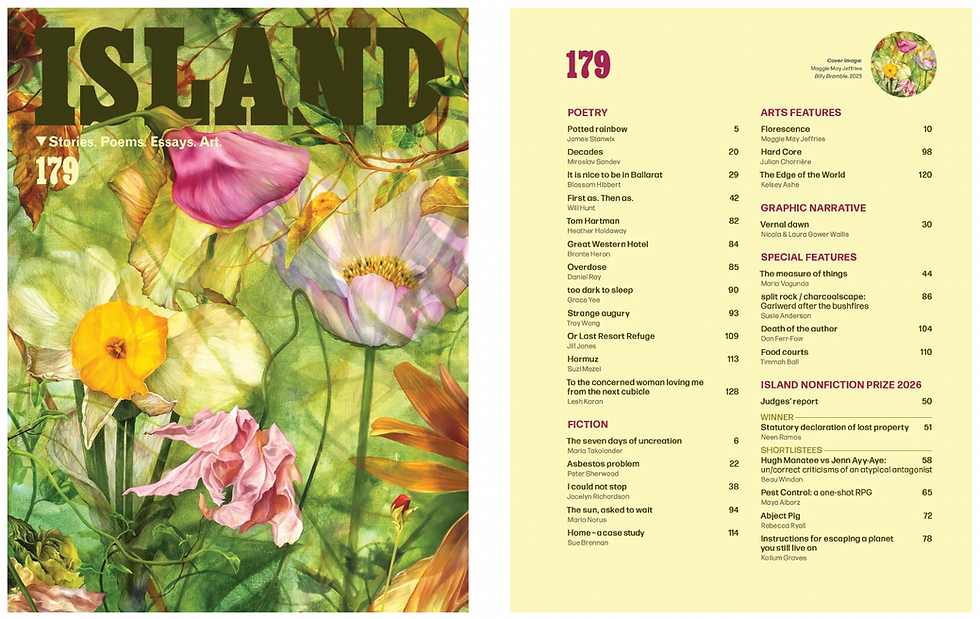
Click here to see the Illustrated Essay from Island Magazine - or simply read the essay below.
The Edge of the World
By Dr. Kelsey Ashe
Near Arthur River, in Lutruwita's remote north-west, lies the landscape of my
childhood; the Tarkine (Takayna) Rainforest, the largest remaining tract of Gondwanan cool
temperate rainforest in Australia. Vast Westerly beaches, shipwrecks and pristine
ancient forests formed the backdrop to a free-range childhood spent wandering alone,
rock-pooling and spying on platypus in the dark river that wound through our property. Each
time I return, I marvel that I grew up somewhere so remote and wild. I realise now that I was already forming what I would later come to call my ‘Imaginary Aesthetic Territories’: the layered inner landscapes that would echo throughout my artworks, essays, exhibitions and novella, in a sustained quest to capture that terrain of unsettling beauty and terror.
Strahan, a four-hour winding drive south, will lead you even further into the extreme frontier
of the south-west, through a coastline that is treacherous and pristine. In the other direction,
the fishing village of Stanley maintains some of Australia’s oldest colonial stone buildings,
dating to 1820s Van Diemen’s Land. Even back then the same questions I consider now,
were forming – what does this landscape hold? How do I belong within it?
Returning to Hobart in 2026 for Hadley's Art Prize has prompted me to reflect on the strange
persistence of place. How landscapes remain within us. How childhood terrains become
creative territories. How an island can continue to shape a life, long after we leave it and how
“belonging” is something that can move with us, though we can never possess it.
It never occurred to me as a child that the natural world was inanimate. My brothers got
around on motorbikes, but I preferred the slow roam into the tangles. The bush felt alive,
communicative and watchful. I spoke to it and, in my own way, believed it spoke back. It
left me gifts: shells, feathers, bones and strange treasures washed ashore or hidden among
eucalypt roots. I left gifts in return, arranging mossy forest-floor altars from whatever
materials I could gather. I still remember the day a group of us discovered a letter in a corked
bottle buried amongst the dunes at Sandy Cape. It felt entirely plausible that the landscape
might communicate in such a way.
Yet alongside wonder there was another feeling. I sensed the colonial atrocities festering at
the edges of cliffs and whistling though grasslands. Certain places filled me with such dread,
though I could not always explain why. My Catholic convent school education taught me
something of the brutal history of the region. During the nineteenth century, the far north-
west corner of Lutruwita became a site of extraordinary violence. Palawa communities
were devastated and much cultural knowledge was disrupted or lost. Places such as Cape
Grim and the windswept coastlines seemed to carry traces of these histories. I sensed it.
Looking back, I suspect that my lifelong fascination with the Australian Gothic began there:
in the uneasy recognition that landscapes can hold beauty and grief simultaneously.
Mostly I felt that I belonged deeply to that place, but I was also captivated by ‘elsewhere’.
The calling unrest of the horizon stirred me full of an unnamed yearning as a young adult.
When dawn rose over Bass Strait every single day, I swore something was calling me away,
like a vision trying to form, then evaporating in sunlit fog.
Through my parents' books and travel albums I encountered images of Japanese
pagodas, Polynesian villages and distant foreign cultures that seemed impossibly
exotic from my small Tasmanian ‘backwater’ world decorated with reproductions
from the Heidelberg School. Even then I seemed to be pulled by two opposing forces: a
profound attachment to place and an equally powerful longing for distant worlds. It was here
I learned how the imagination can cross the ocean well before the body does. That
imaginary vision holds something potent, a blend of known and unknown.
Long before I could name it, I was hungry for ‘culture’. Not simply art or literature, but a way
of understanding how I belonged within the long human story. I don't think that question
ever formed itself into words as a child, but the search had already begun in the forests of the
Tarkine. In nature I belonged instinctively. In culture I wasn't always sure where to stand.
The bush never asked me to explain myself. Rivers, birds and weather accepted my presence
without question. Human history was more complicated.
As I grew older, I began tracing my own ancestry to the Celtic landscapes of Western
Scotland and Coastal Ireland. I felt the marrow of ancestral toil in my bones and I recognised
something of those coastlines in my imagination, yet they could never fully explain who I had
become here, on this island at the edge of the Southern Ocean. What is it to be an Australian
anyway if I am not Indigenous? Belonging, I realised, is never singular. I think our roots do
not descend vertically into one place but spread laterally, like rhizomes, connecting many
landscapes, generations and stories.
My childhood in Tasmania was idyllic, but my horizons expanded dramatically
during my late teens when I lived in New Zealand with my Tasmanian-born
father. His own life had become deeply intertwined with Japan. He later spent
years there building churches, and many of the women who entered our lives were Japanese.
Through them I encountered a quiet attentiveness to beauty and the material culture of
Japan that felt strangely familiar. It wasn't spectacular or ornamental. It lived in subtle
gestures, careful observation, restraint and the significance of what was left unsaid. Long
before I understood Japanese aesthetics intellectually, I had begun to absorb something of
their sensibility.
Years later, while undertaking my doctorate in Western Australia, I encountered the Japanese
aesthetic philosophy of yūgen and found myself pursuing it within an Australian context. The
word resists direct translation, but gestures towards mystery, depth, shadow and the awareness of something vast and profound that can be sensed yet never fully explained. In Japanese aesthetics, yūgen often resides in suggestion rather than disclosure: the moon half-hidden by cloud, a mountain dissolving into mist, the emotion that lingers after an image has disappeared. I remember thinking, with a kind of relief, there is a word for this.
It was not that Japan had given me a new way of seeing. Rather, it had offered language for
something I had first encountered as a child wandering alone through the Tarkine. The bush
had already taught me that the most powerful presences are rarely the most obvious. They
wait at the edge of perception, asking only that we learn to pay attention.
Today my father is buried overlooking Lutruwita's wild west coast, at ‘home’ in Taypalaka (Green Point). Whenever I return, I find myself speaking to him beneath the same weather that shaped both our lives. His body has become part of that landscape now: the ferns, the river, the rain. I think he understood, long before I did, that belonging is not something we inherit. It is something we continue. It lives in returning. It lives in acts of care. It lives in tending the places and people that continue to shape us long after we have left.
Leaving Tasmania did not loosen my connection to landscape. Instead, distance
sharpened it. The forests and rivers of my childhood became less a place I had lived
than a way of seeing the world. As I travelled, studied and eventually completed a
doctorate in art, I found myself searching not only for artistic methods but for ways of
understanding the strange pull I had always felt towards particular places. I read philosophy,
ecology, mythology and anthropology, yet I discovered that scholarship did not replace
intuition or knowledge gleaned by just being in nature—it simply gave me new language with
which to think about it.
During my research I found myself returning again and again to the Surrealists. What
attracted me was not their visual language as much as their courage. They insisted that
dreams, intuition, coincidence and the irrational were not illegitimate remnants of pre-modern thought, best to be discarded, but legitimate ways of knowing the world. I recognised
something of my own childhood in that proposition. The forests of the Tarkine had already
taught me that not everything meaningful announces itself through reason alone. There are
invisible things we cannot explain, but somehow know. The sun filtering through the trees to
land upon my skin in winter taught me more than any book ever could. For the first time I
encountered an artistic tradition that treated dreams, intuition and coincidence not as childish
fantasies but as legitimate ways of paying attention.
The older I become, the less I think an artist's education is about acquiring techniques. It is
about refining attention. Learning what to notice. Learning to remain with uncertainty long
enough for something to reveal itself. The Tarkine taught me that first. Japan later gave me
words for it. Scholarship gave me frameworks. Art and writing became the practice of
returning to that attentive state, again and again.
I look back and see the questions have never really changed. I still want to know why certain
landscapes feel alive. Why some places seemed to remember. Why beauty and grief can
inhabit the same shoreline. The entanglement of memory, place, spirit and perception, all co-
existing. Why the horizon can call us beyond ourselves while the ground beneath our feet
insists, we belong. It wasn't until years later that I encountered Ghassan Hage's beautiful idea
of "roots that stay with you as you move." I recognised something of myself immediately. My
own belonging had never felt fixed. It travelled. Every landscape I loved became another root
in an expanding underground network.
My artworks became conversations between landscapes. Like a dream, where you
can be in two places at once, or have two views at once, or even be living multiple
lives, at once. A recognisable land formation from Lutruwita might appear beside
a shoreline that exists in Western Australia, the home I ended up in. Lands could hold a
thousand myths. This vast geographical swathe of the Southern Hemisphere, would welcome
Venus above them all, looping endlessly across the horizon as though time itself had folded. I
realised I wasn't trying to reconstruct any single place faithfully. I was trying to draw the
geography of memory. Memory certainly doesn't obey maps. It gathers places together
because they share a feeling rather than a border. I began thinking of my artworks as
occupying an "everywhen." Past and present sit side by side. Myth and geology coexist. Day
and night overlap. A shoreline can shift, glow, hover.
Screen-printing with botanical and rare-earth pigments became my chosen language. Each
present, even when hidden. Memory behaves much the same way.
We often imagine belonging as a fixed point on a map. My experience has been almost the
opposite. Belonging has grown through movement. Each place I have loved has extended the
underground network of roots from which my work continues to grow. Layered like my
prints, a wash of colour in shadow and light, deepening the focus of revelation.
The lone she-oak in my Hadley's Art Prize screen-print ‘Staying with the Mystery’ grows
from bare limestone on Jenalup Beach, a sacred women’s site in Nyungar culture.
The limestone cliffs draw in light and exhale it at dusk, the nook of the beach holds
you in sanctuary. That she-oak has become, for me, an emblem of belonging to many places.
Its roots do not disappear beneath the earth. They travel across the rock itself, exposed to
weather, gripping every fissure they can find. Year after year it faces the full force of the
westerly storms. It has not survived because conditions were gentle. It has survived because its
roots learned how to hold on.
Perhaps belonging is something like that. Not ownership or certainty, but a practice of
attention. A willingness to be shaped by place, and in return to care for it. The landscape
once left gifts for a curious child wandering alone through the Tarkine. Everything I make
now is my attempt to leave something in return.
Dr Kelsey Ashe is a Tasmanian-born artist, author and researcher whose interdisciplinary practice spans printmaking, writing and environmental humanities. Working across visual art, literature and scholarship, she explores landscape, mythology, ecological imagination and the sublime. She is a finalist in the Hadley's Art Prize 2026 and the author of The Deep Green Sea.


Comments